
Agentic Commerce: The Next Evolution of Digital Retail


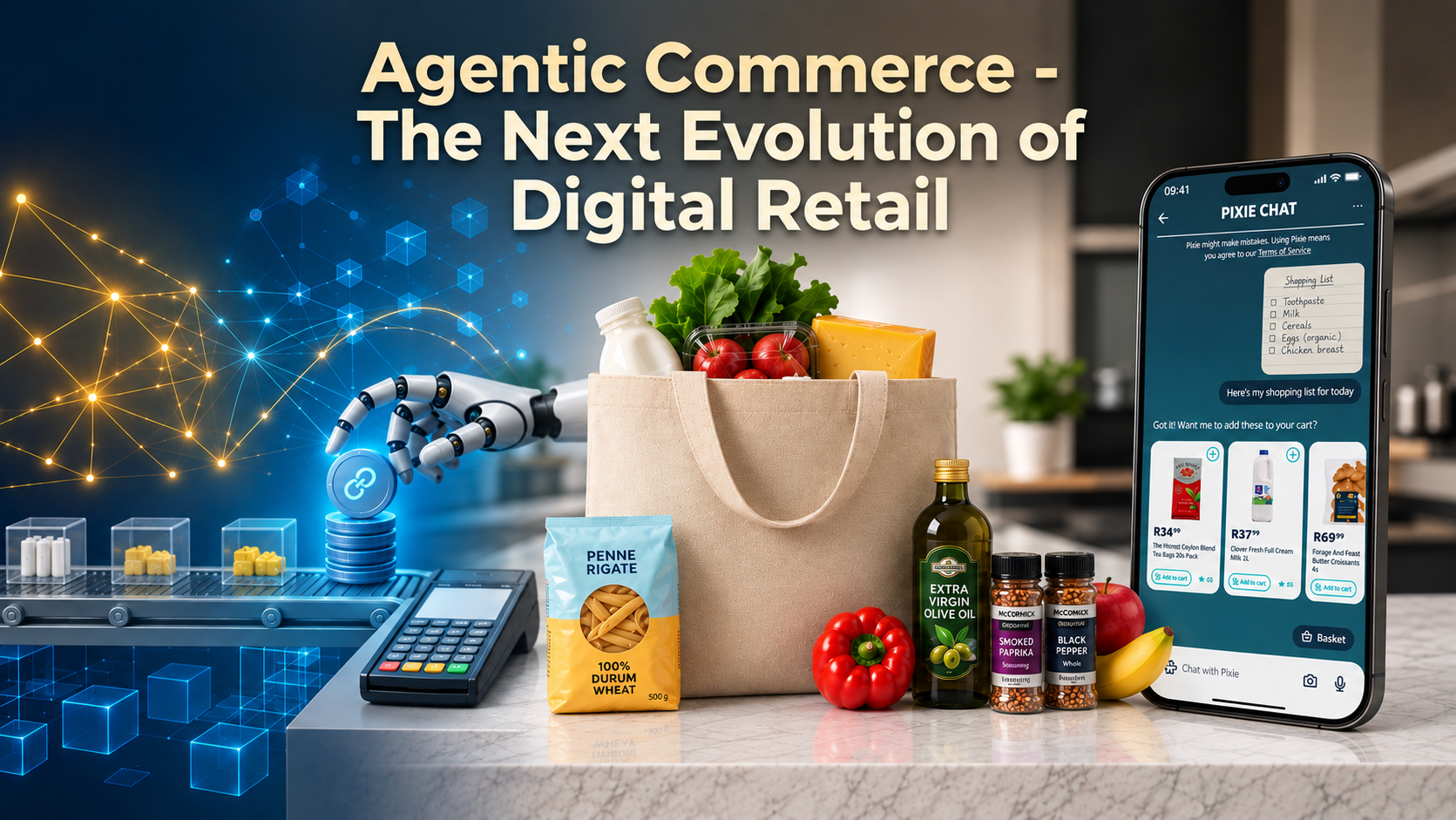
I have been a Checkers Sixty60 user for a while now, mostly out of convenience, and over the past few months I noticed the app doing something different, it started anticipating my basket before I had typed a single search term. That small shift is what first got me curious about agentic commerce, and it is what led me to sit down and write this piece. I wanted to understand what was actually happening behind that swipe-to-add basket, and whether it was a genuine shift in how we shop or simply a clever bit of app design.
Agentic commerce refers to autonomous AI systems that shop on a consumer's behalf, discovering products, negotiating terms, and completing purchases with little to no direct human input. By mid-2026, this has moved from a futuristic concept to a real, deployed feature of everyday retail. Global technology and payments companies, including Google, Amazon and Visa have announced standards and infrastructure to support so-called “agentic commerce.” Closer to home, South African grocery retailers are already rolling out AI shopping assistants capable of building a customer's basket for them.
The underlying shift is significant: commerce is becoming more conversational and intent-driven. Rather than clicking through categories, customers can simply describe what they want, and an AI agent handles the rest.
Defining Agentic Commerce and Its Evolution
At its core, agentic commerce describes AI systems acting on a shopper's behalf to handle parts of the buying process. Early steps in this direction appeared around 2023, with chatbots such as Alexa and Google Assistant and the rise of smart search. What is new in the 2024–26 period is that agents are beginning to execute transactions autonomously, rather than simply answering queries. They can interpret a customer's intent (for example, “I need ingredients for lasagne”) and then perform searches, apply filters, select items, and even negotiate coupons, all through conversational prompts. This builds on advances in large language models (LLMs) and multimodal AI, which allow machines to understand complex, free-form requests. Where traditional e-commerce relied on “search and scroll,” agentic commerce inverts the model: the customer's role shifts toward stating high-level goals, while the AI manages the details.
Agentic commerce sits atop a convergence of several trends: powerful LLMs and multimodal AI, real-time payment and delivery APIs, rich loyalty data, and new protocols for secure agent transactions. Google's Universal Commerce Protocol, for instance, is exploring ways for digital assistants to interact across retailers, while Visa is developing agentic payment rails to allow autonomous agents to check out on a user's behalf. In short, the ecosystem is maturing to the point where an AI agent can manage an entire shopping trip, much as a human assistant would.
Core Technologies Enabling Agentic Commerce
- Large language models and multimodal models: Modern LLMs, such as OpenAI's GPT-4/5 and Google's Gemini, serve as the “brains” of these agents. They can understand nuanced language and generate natural responses. Multimodal models extend this by processing images or receipts, for example allowing an agent to interpret a photographed recipe or a handwritten shopping list. These models can also be grounded with up-to-date product data, so they know what is available, at what price, and from which sellers.
- Retrieval and RAG (Retrieval-Augmented Generation): Agents must fetch current product information, including catalogues, pricing and inventory, on the fly. RAG techniques allow an AI agent to query external databases or search APIs in real time, so its recommendations remain timely and accurate. In a shopping context, this means an agent can search a retailer's inventory to find items that precisely match a customer's request or recipe.
- Tool use and APIs: to act, meaning adding items to a cart, applying coupons and processing payment, agents rely on integrations and APIs. Visa and Mastercard, for example, are building protocols that let AI agents execute payments via tokenised credentials, while retailers and platforms are exposing their e-commerce functions via APIs so that agents can browse products, read reviews, and place orders programmatically.
- Orchestration and protocols: behind the scenes, orchestration layers connect the AI model to the relevant tools. Emerging standards, such as Visa's Agent Payments Framework and Google's intents APIs, are designed to ensure that different agents and retailers can communicate securely. These layers authenticate the agent (confirming it is authorised to act on a user's behalf) and ensure that any actions, such as purchases, follow the user's rules and preferences.
- Security, privacy and trust: because agents can complete purchases and store sensitive data such as addresses and payment information, robust safeguards are essential. These include requiring explicit user permission before any purchase, limiting spend per transaction, real-time fraud checks, and encryption of personal data. Shoprite's Pixie, for example, uses only anonymised loyalty data to predict needs, and transactions still require the user to confirm payment at checkout.
Business Models and Monetisation
Agentic commerce remains a developing field, but several potential business models are already emerging:
- Retailer as provider: retailers such as Amazon or Walmart may offer their own shopping agents, aiming to increase order frequency and basket size, monetising through increased sales and cross-sells.
- Platform as intermediary: technology platforms such as Google or Apple could offer agentic shopping as a service, taking a cut of transactions or charging retailers for access.
- Subscription and loyalty integration: companies may bundle agent features into premium tiers or loyalty programmes. Shoprite, for instance, has already tied its Pixie assistant to its Xtra Savings paid subscription, encouraging sign-ups.
- Data and insights: agents generate rich data on consumer intent and preferences, which companies might monetise as anonymised insights or use to tailor marketing.
Overall, monetisation is likely to blend existing e-commerce models (commissions, advertising, affiliate links) with newer approaches, such as paid “upgrades” to agent capability or access to specialised shopping assistants.
UX, Trust, Ethics and Regulation
Agentic shopping changes the user experience fundamentally: instead of screens and menus, interactions become conversational. This introduces new design challenges, such as ensuring users understand what an agent is about to do, as well as ethical considerations around preventing manipulation and ensuring fairness. Trust is central to adoption: customers need confidence that their agent is working in their interest, rather than being influenced by undisclosed sponsorships. In South Africa and globally, regulators are beginning to consider how to make agentic commerce transparent, for instance by requiring agents to disclose when a product recommendation is paid for.
A number of open questions remain, including how to prevent runaway spending by overly eager agents, and how to ensure the privacy of shopping data. Early implementations are helping to refine best practice. For now, leading companies emphasise that the human user retains final approval before any purchase is completed, which helps to mitigate many of these ethical concerns.
South African Grocers Lead the Charge
In South Africa, major grocery retailers have moved quickly to turn agentic concepts into reality.
Shoprite's online service Sixty60 launched the Pixie AI assistant in April 2026, with results that have already proven remarkable. Pixie has been adopted by 98% of Sixty60's paid subscribers within three months, making it one of the fastest-adopted features in the app's history. Through Pixie's swipe-to-add interface, customers have placed over 4 million items into their baskets. Its most enthusiastic user has swiped 730 items (R36,236) into their basket, while another customer completed an entire 10-item, R1,500 shop in just 15 seconds. This real-world data illustrates how Pixie's predictive Smart Basket and intuitive interaction are removing friction: as ShopriteX's Neil Schreuder puts it, every unnecessary tap, search and scroll that Pixie removes is friction taken out of the shopping experience. I have used Pixie on my ownSixty60 shop, and the Neil Schreuder quote rings true from my own experience, a weekly restock that used to take me a good ten minutes of searching now takes closer to one.
Pick n Pay followed suit soon after. On 6 July 2026, it activated Penny, a conversational AI assistant within its ASAP! app. Unlike Pixie's predictive model, Penny begins with open-ended conversation: users can text, speak, or even photograph a shopping list. Powered by Google's Gemini LLM, Penny interprets these prompts and builds the basket accordingly. Early messaging from Pick n Pay emphasises a shift toward “conversation-led” shopping: Penny can respond to broad requests, suggest ingredient substitutions, help plan meals or budgets, and even provide recipe ideas as it builds an order. In short, while Pixie learns a customer's typical list, Penny allows customers to express new shopping intentions in natural language.
Woolworths is now joining the race. In mid-2026, the retailer announced My Woolies Chef, an AI-powered cooking and shopping assistant built into the Woolworths app. This agent answers questions such as “What's for dinner tonight?” by drawing on 20 years of Woolworths Taste recipes. My Woolies Chef uses generative AI to parse a user's request (accounting for factors such as family size, dietary preference, or available pantry ingredients), recommends recipes, and then automatically generates a complete shopping basket in Woolies Dash with a single click. MyWoolies Chef is not yet fully live: it enters a controlled beta with loyalty members in September 2026, with a wider rollout planned for early 2027. Even at the announcement stage, however, it signals Woolworths' intent to make commerce conversational; the company's data and AI officer, Jose Rodrigues, has explained that instead of customers navigating multiple searches, they will be able to describe their needs in everyday language and receive contextually relevant suggestions.
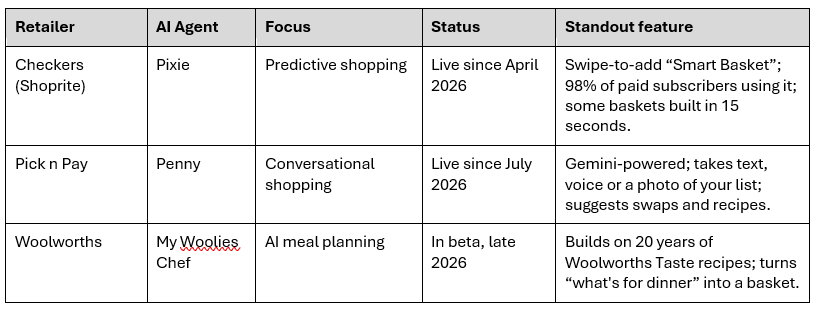
These developments illustrate that South African retail is at the forefront of agentic commerce. Checkers' Pixie and Pick n Pay's Penny are already helping customers shop faster, and Woolworths is preparing an intelligent meal-planning agent. Other players are likely to follow: Spar's 2U platform, for example, has hinted at future AI enhancements. The net effect is a shift from menu-driven shopping toward outcome-driven shopping: customers simply state what they want, and the AI agent takes care of the details.
Business Case: Why It Matters
The rapid rollout of AI assistants by South African grocers underscores a broader global trend: retailers increasingly view conversational AI not as a novelty, but as a competitive necessity. Just as e-commerce moved from desktop to mobile, it is now moving from app to agent. Agents can drastically shorten the time and effort involved in shopping: Pixie's 15-second purchase, for example, would traditionally involve many minutes of browsing. This “speed of intent” can increase order frequency and basket value. It also strengthens customer loyalty: when an AI genuinely “knows” a customer, it can surface deals and products matched to their habits, creating a more personalised experience.
Moreover, agentic commerce extends beyond shopping itself; it embeds commerce within the broader context of customers' lives. Woolworths' approach of beginning from a cooking question demonstrates this well: rather than stating “I need chicken,” a customer might say “I want to make a chicken and mushroom pasta,” and the system handles the rest. This end-to-end convenience, from idea, to meal, to basket, to doorstep, can meaningfully differentiate a retailer in a crowded market. According to Pick n Pay, the goal is to remove effort from shopping altogether, making retail service feel almost anticipatory.
For South African consumers, this means retail services are becoming smarter and more tailored to individual needs. For retailers, it means exploring new revenue streams, such as premium AI features and more efficient cross-selling, alongside richer data on what customers truly intend to do. Globally, Visa and other platforms are also preparing to monetise agentic commerce; Visa, for instance, is working on standards to support secure, autonomous payments at scale. Beyond the examples discussed here, incumbents such as Amazon and Google are testing their own variants, and e-commerce platforms including Shopify and Salesforce Commerce Cloud are building toolkits to help merchants integrate agents of their own. The South African case, however, remains a vivid and early example of agentic commerce already at work.
Conclusion
Agentic commerce represents a fundamental shift in digital retail: commerce is becoming conversational and autonomous. Instead of requiring customers to navigate complex digital storefronts, businesses are bringing the store to the conversation. For organisations, this shift means rethinking the customer journey: designing platforms where customers “speak” their needs and AI partners act on them. The businesses that lead will not necessarily be those with the cheapest products or fastest delivery; they will be those offering the smartest shopping experience.
The evidence is already accumulating. In early 2026, South African grocers turned the speculative into the tangible, with customers purchasing thousands of rand of groceries in mere seconds via AI assistants. These local developments mirror global moves by Visa, Google and others, together signalling that shopping itself is evolving into a service one converses with. In the years ahead, agentic commerce can be expected to mature from pilot to mainstream, much as mobile commerce did a decade ago. The question facing businesses today is not whether AI will influence retail, but how they will choose to integrate with it. Those that do so thoughtfully stand to turn AI from a buzzword into a seamless part of the customer experience.
Writing this piece has only sharpened my own curiosity about where this goes next. What started as a simple observation about my own Sixty60 basket has turned into a genuine interest in how South African retailers are shaping a global trend, rather than just following one. I will be watching Penny and My Woolies Chef closely over the coming months, and I'd encourage you to try Pixie, Penny or a similar assistant for yourself if you haven't already, it's a rare case where the experience of using the technology says more than any article can.
------------------------------------------------------------------------------------------------------------
Sources: industry reports, newscoverage and company announcements referenced above.


.svg)
.svg)
